Problems & Puzzles: Puzzles
|
Problems & Puzzles: Puzzles
 *** From 8 to 15, May, 2026, contributions came from Emmanuel Vantieghem, Carlos Rivera Emmanuel wrote:
The number of emirps with n digits can be found in https://oeis.org/A152014 :
{0, 8, 28, 204, 1406, 9538, 70474, 535578, 4192024, 33619380, 274890230, 2294771254} (for n = 1 to 12). From this, we find the number of emirps < 10^n : {0, 8, 36, 240, 1646, 11184, 81658, 617236, 4809260, 38428640, 313318870, 2608090124}. The number of primes < 10^n is: {4, 25, 168, 1229, 9592, 78498, 664579, 5761455, 50847534, 455052511, 4118054813, 37607912018}. The quotient of these numbers is (we took n > 1) : {0.32, 0.16667, 0.16599, 0.14658, 0.12151, 0.10604, 0.092959, 0.082443, 0.073880, 0.066752, 0.061018} Here is a plot 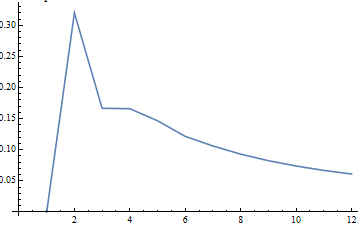 It is clear that we have too little data to formulate a decent conjecture. But if I was forced to make a guess, I would say that the curve could tend to a limit. And I would choose a limit value which depends on 10, our number base. A "good" one could be 1 / (10 ln 10).~ 0.043429448. That would lead me to the conjecture : Em[x] ~ x / (10 (ln 10) ( ln x)). This is widely far from n / (log(n)^2. But I would not bet on it ! *** Carlos wrote: Here are my counts asked in Q1 & my comparison to the formula proposed in Q2 Note: By definition an emirp exclude the palprimes: "An emirp (pronounced /ˈiːmərp/ or /ˈɛmərp/, an anadrome of prime) is a prime number that results in a different prime when its decimal digits (digits in base 10) are reversed.[1] This definition excludes the related palindromic primes...." From https://en.wikipedia.org/wiki/Emirp I'm not sure if I'm making a correct interpretation of the Simon's phrase in Q2. "Compare it to n/(ln(n)*ln(n))". But here I go with my turn
***
|
||||||||||||||||||||||||||||||||||||||||||||||||||||||||||||||||||||||||||||||||||||||||||||||
|
||||||||||||||||||||||||||||||||||||||||||||||||||||||||||||||||||||||||||||||||||||||||||||||
|
||||||||||||||||||||||||||||||||||||||||||||||||||||||||||||||||||||||||||||||||||||||||||||||


